

Lore - Imperium of Man: Galactic Conquest and Daddy Issues
A Satirical Lore Overview Parody of The Human Faction of Warhammer 40k.

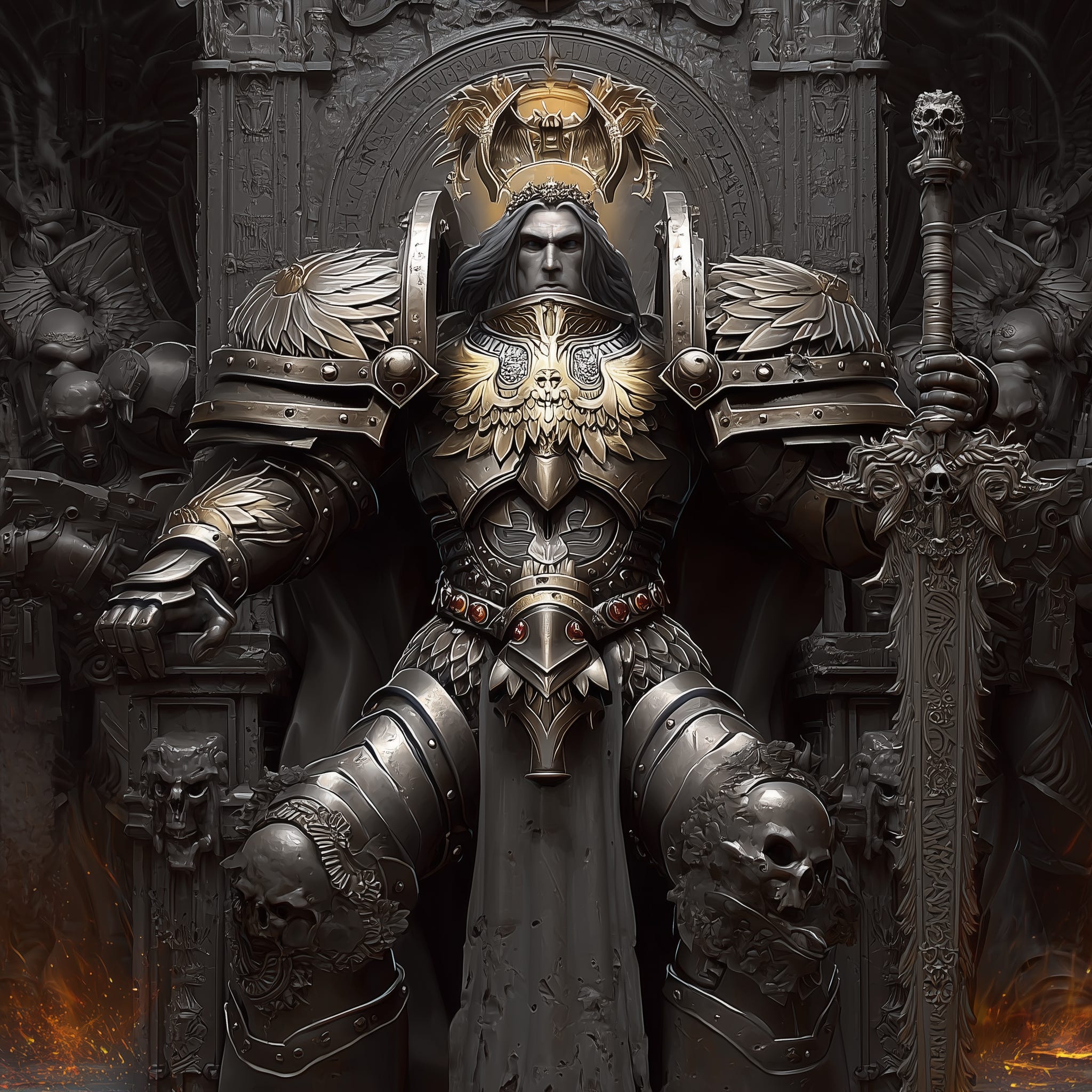
In the annals of galactic history, few leadership stories compare to that of the Emperor of Mankind—a tale that begins with humanity’s greatest hope and ends with what can only be described as the longest family reunion in recorded existence. This is the story of a ten-foot-tall psychic demigod who united humanity, created superhuman sons to lead his armies, and then watched as literally half of them staged the galaxy’s worst family intervention.
The Emperor: Humanity’s Overachiever
The Emperor of Mankind was, by all accounts, exactly the kind of person who makes everyone else feel inadequate at family reunions. The Emperor, to put it mildly, was exceptional. Standing at ten feet tall with psychic powers that would make most wizards weep with inadequacy, he represented humanity's absolute peak potential. Think of him as that one person in your high school who was captain of every sports team, valedictorian, and somehow also had time to cure cancer and learn seventeen languages. Except instead of going to a good college, he decided to conquer the galaxy.
The Emperor was a psyker—a term that in the Warhammer 40,000 universe, is someone who can tap into the Warp—that delightful nightmare dimension we discussed earlier—and channel its power through their mind to accomplish various feats. Think of it as having access to the universe’s most dangerous power outlet, except instead of risking electrocution, you’re risking demonic possession, spontaneous combustion, or accidentally turning your brain inside out. The Emperor, naturally, was a god-tier psyker, which is the psychic equivalent of being so good at something that they had to invent a new category above “perfect” just to properly classify your competence level.
The Great Crusade: When Things Were Going Well
Approximately ten thousand years before the current setting of Warhammer 40,000, the Emperor embarked on what historians would call the Great Crusade—a galactic expansion project that combined the ambitious scope of manifest destiny with the subtle diplomacy of a sledgehammer. His goal was simple: unite all of humanity under one banner, spread across the stars, and create a glorious future free from superstition and religious extremism. We’ll circle back to how that worked out for him.
To accomplish this monumental task, the Emperor created the Primarchs—twenty genetically engineered superhuman sons, each designed to be a master of warfare, leadership, and presumably holiday dinner conversation. These weren’t just any children; they were demigod-level beings, each capable of leading entire legions of Space Marines (his other, slightly less impressive superhuman creations) across the galaxy to bring worlds into compliance with the Imperial Truth.
It’s worth noting the precise nature of “bringing worlds into compliance,” which is a phrase that does a remarkable amount of heavy lifting in this context. Much like how “helping someone move” can mean anything from carrying a few boxes to renting a U-Haul and spending your entire weekend dismantling furniture, “compliance” ranged from peaceful diplomatic integration to... well, significantly less peaceful alternatives involving orbital bombardment and the systematic elimination of anyone who disagreed with the Emperor’s vision for humanity’s future.
The Horus Heresy: The Favorite Son’s ‘Rebel’ Phase
Here’s where our story takes a turn that makes most family feuds over inheritance look like polite disagreements. Horus, the Emperor’s favorite son and the Primarch he trusted most—you know, the golden child who could do no wrong at every family gathering—decided to stage a coup. But not just any coup; a coup backed by the four Chaos Gods, those delightful entities residing in the Warp who make your standard evil overlord look like a neighborhood watch coordinator with moderate authority issues.
Now, to understand the Chaos Gods, imagine Satan. Got that? Good. Now, while you’re contemplating what could possibly be worse than Satan, think: oh, I know—two Satans. Now double it. These four beings—Khorne (the blood and skulls enthusiast), Tzeentch (who schemes for the sake of scheming), Nurgle (grandfather of all plagues), and Slaanesh (whose interests we’ll politely describe as “excessive”)—decided that corrupting half of the Emperor’s sons would be an entertaining afternoon project.
Through a series of manipulations, betrayals, and circumstances that would require several volumes to properly detail (the Horus Heresy book series currently stands at well over fifty novels, which should give you some indication of exactly how complicated this family drama became), Horus managed to convince eight of his brothers to join him in rebellion. That’s nine out of eighteen Primarchs, for those keeping track at home—the kind of family split that makes your parents’ divorce look like an amicable separation where everyone still gets together for the holidays.
The Horus Heresy culminated in a siege of Terra itself, where Horus and his traitor brothers brought the fight directly to humanity’s homeworld. The final confrontation between the Emperor and his corrupted son took place aboard Horus’s flagship, in a duel that ended with Horus dead and the Emperor mortally wounded. And when I say “mortally wounded,” I mean wounded to a degree that would have definitively killed anyone else, but which for the Emperor resulted in something far worse: an existence trapped in the twilight between life and death, seated upon the Golden Throne.
The Golden Throne: Humanity’s Most Expensive Life Support System
Following the Heresy, the Emperor’s shattered body was interred within the Golden Throne, a device of such technological sophistication that its operating manual was presumably written by someone who thought IKEA instructions weren’t confusing enough. This arcane piece of Dark Age technology serves several crucial functions, the most important of which is keeping the Emperor’s consciousness active enough to power the Astronomican—the psychic gps that makes interstellar travel possible for all your family road trips.
The Astronomican functions as the human’s galaxy navigation system, a beacon in the Warp that allows ships to navigate through that demon-infested dimension without getting hopelessly lost, arriving at their destination several centuries late, or emerging from Warp travel to discover that everyone aboard has mysteriously disappeared except for one survivor who will only speak in backwards Latin. To maintain this beacon, the Emperor must remain perpetually alive on the Golden Throne.
Here’s where we encounter what might be the galaxy’s most expensive maintenance requirement: the Golden Throne requires a daily sacrifice of approximately one thousand psykers to keep the Emperor alive and functional. These psykers—individuals whose souls burn bright enough to be detected from across the galaxy—are collected, transported to Terra (often spending years or decades just to reach Earth, given the vastness of space and the general inefficiency of Imperial logistics), processed through the appropriate bureaucratic channels (which involves forms we discussed in the previous article), and then fed to the Emperor’s barely-living corpse to sustain his consciousness for another day.
If you’re doing the math at home, that’s approximately 365,000 psykers per year, or 3,650,000 per decade, which over ten thousand years amounts to... well, let’s just say that if humanity had a loyalty rewards program based on the number of psykers sacrificed to keep your cosmic lighthouse running, we’d have earned enough points for several free trips to any destination in the galaxy. Assuming, of course, that the Golden Throne doesn’t fail, because the moment it does, interstellar travel ends, the Imperium collapses, and humanity likely goes extinct in a relatively short period of time—historically speaking, naturally. We’re talking centuries rather than millennia, which in the grand scheme of civilizational collapse is practically overnight.
The Irony: From Imperial Truth to Imperial Cult
Perhaps the greatest tragedy—or comedy, depending on your perspective—of the Emperor’s current situation is the dramatic shift in how humanity views him. During the Great Crusade, the Emperor championed the Imperial Truth, a doctrine that explicitly rejected superstition, religious belief, and the worship of any gods. He insisted, with the confident certainty of someone who has never encountered a problem that couldn’t be solved through superior firepower and genetic engineering, that reason and science would guide humanity to greatness.
Fast forward ten thousand years, and the Emperor is now worshipped as the God-Emperor of Mankind, the central figure of the Imperial Cult, venerated across a million worlds by quadrillions of faithful believers who pray to his divinity daily. The Ecclesiarchy, the massive church devoted to spreading the Emperor’s divinity, has become one of the most powerful institutions in the Imperium. It is, one must admit, probably the last thing the Emperor would have wanted—a point that would be funnier if he could actually express his feelings on the matter instead of being trapped in an endless state of psychic screaming while keeping the galaxy’s most important lighthouse operational.
The Imperial Cult teaches that the Emperor is humanity’s one true god, that faith in him is humanity’s greatest weapon, and that deviation from this belief constitutes heresy of the highest order. Heresy, in the Imperial lexicon, covers an impressively broad range of offenses: believing in other gods, not believing in the God-Emperor with sufficient fervor, believing in the God-Emperor but in the wrong way, expressing curiosity about pre-Imperial history, suggesting that perhaps throwing a thousand people per day into a golden corpse-throne might be ethically questionable, or generally thinking thoughts that haven’t been pre-approved by your local Ecclesiarchy representative.
The punishment for heresy is, almost universally, death. Though to be precise, it’s often death preceded by extensive interrogation to ensure you haven’t corrupted anyone else with your heretical thoughts, followed by a public execution designed to remind everyone else why independent thinking is strongly discouraged in the 41st millennium.
The Current State of Affairs
Ten thousand years after the Horus Heresy, the Imperium has degraded significantly from its Great Crusade glory days. Technology has regressed to the point where much of the advanced equipment from that era can no longer be manufactured or understood, leading to a civilization that treats its remaining high-tech artifacts like religious relics—which, given the Imperial Cult’s influence, they quite literally are.
The Adeptus Mechanicus, the organization responsible for maintaining humanity’s technology, doesn’t so much “repair” machines as they perform elaborate religious rituals involving sacred oils, prayers to the Machine Spirit, and the precisely correct sequence of percussive maintenance (hitting it with a wrench while chanting the proper hymns). Whether these rituals actually work because of genuine machine spirits inhabiting the technology, or because the Mechanicus has simply ritualized the correct technical procedures while forgetting why they work, is a question best left to tech-priests with too much time and an unusually high tolerance for heresy accusations.
The Imperium now exists in a state of perpetual decline, fighting an endless defensive war against aliens (collectively called “xenos” and universally marked for extermination), Chaos worshippers (who definitely deserve the extermination part), and its own bureaucratic inertia (which nobody can do anything about because the forms required to reform the bureaucracy have been lost for three thousand years, and the department responsible for finding lost forms was disbanded in M37 due to budget cuts that were never actually recorded in the proper ledger).
In the grim darkness of the far future, your dad became a god against his will, half your brothers tried to kill you in the worst birthday party in human history, and the only thing keeping civilization running is a 10,000-year-old corpse on life support that requires the daily sacrifice of a thousand people.
Remember, the Emperor watches over you. Technically. In a “vegetative state on a golden throne” sort of way. It’s fine. Everything’s fine. Please fill out Form 872-H/Heresy Declaration if you think otherwise.
I hope you had fun with this satirical overview of the lore of Warhammer 40k. If you did be sure to check out our other lore posts. Subscribe so you can stay up to date. Please tell us what you enjoyed and what else you’d like to see. Thanks!